
Workplace Emergency Response Guide
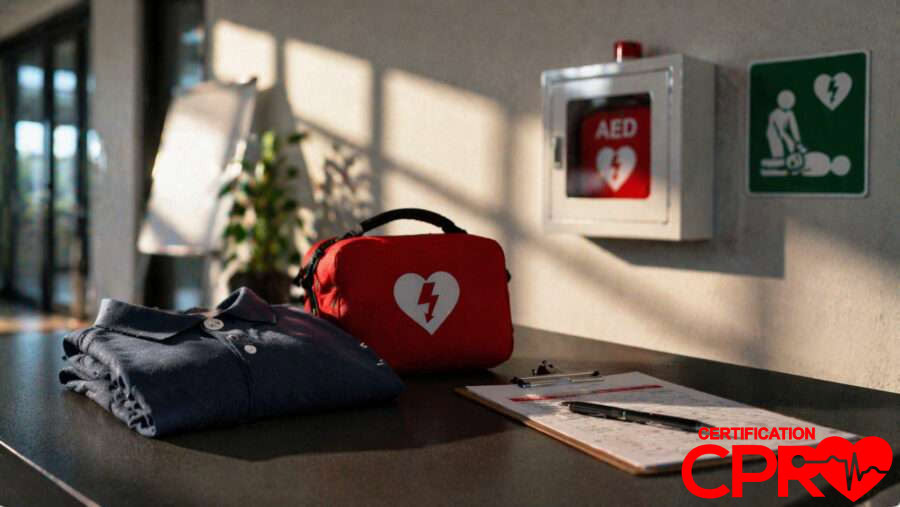
Workplace emergency plans usually fail when nobody has practiced them. The AED is on the wall, the first aid kit is in a cabinet, the policy is in a binder, and the people who would respond have never worked through the emergency as one team.
A better setup feels simpler in the moment. The team knows who calls 911, who starts CPR, who grabs the AED, and where that equipment lives. The plan fits the building instead of sounding good only on paper.
That matters whether the building is a medical clinic near TTUHSC El Paso, a warehouse in the Lower Valley off I-10, or a hotel property on the East Side near the airport. When someone collapses, the first response team is whoever is already inside — the coworker at the next desk, the stockroom employee two rooms away, the front desk staff who saw the customer go down.
The job is to remove the blank space between collapse and EMS arrival. In that gap, a trained coworker can recognize cardiac arrest, start compressions, send someone for the AED, and keep the scene organized enough that professional help can take over cleanly.
Upcoming CPR Class Dates and Times
The Importance of CPR Training in the Workplace
OSHA’s medical services and first aid standard, 29 CFR 1910.151, requires trained first-aid personnel whenever a clinic or hospital is not in near proximity to the workplace. For El Paso businesses in industrial corridors, logistics operations along I-10, or commercial facilities spread well east or west of UMC, that requirement addresses a real gap — not an abstract one.
CPR training matters at work because the people already in the building shape the first few minutes, whether they signed up for that role or not. For many El Paso businesses in industrial areas, logistics facilities, or spread-out commercial corridors far from UMC or Las Palmas, the gap between collapse and professional arrival is real time that coworkers are responsible for filling. EPFD response times across El Paso’s 250-plus square miles average eight to ten minutes — long enough that early bystander action is the difference between a viable patient and one whose outcome is already determined before EMS reaches the door.
Hands-on training gives employees more than awareness. It gives them a sequence they can use: call 911, start CPR, get the AED, and keep the response moving until EMS takes over.
That sequence matters because untrained teams tend to lose time in predictable places. Someone assumes another person has called 911. Two people run for the same equipment while nobody starts compressions. The AED is visible but nobody feels authorized to open the cabinet. Training turns those scattered instincts into assigned actions before the emergency happens.
For El Paso employers, the practical question is not whether an emergency is likely on any given day. It is whether the business has enough trained people in the building when the unlikely day arrives. A single trained manager helps, but a stronger plan does not depend on one person being present, on shift, and close enough to respond in time.
Creating a Workplace Emergency Action Plan
A workplace emergency action plan should answer the obvious questions before an emergency ever tests it. Who calls 911? Who starts CPR? Who gets the AED? Where is the first aid kit? Which entrance should EMS use, and who is meeting them there?
A workable plan is short enough to remember and specific enough to use — meaning it names actual people in actual roles rather than listing generic responsibilities that every employee assumes belong to someone else. A vague policy document is not a plan; it is the illusion of a plan. What fails during an emergency is not the absence of information but the absence of assigned, practiced action.
The plan should also fit the actual building. A two-story office building on Montana Avenue has different AED placement and coverage needs than a large distribution warehouse near the Ysleta area or a school with multiple wings across El Paso ISD. The role assignments should reflect those differences, not be lifted from a generic template.
A usable plan names roles before the emergency. One person calls 911 and stays on the line. One person starts CPR. One person retrieves the AED. One person meets EMS at the entrance, opens gates or locked doors if needed, and brings responders to the patient without delay. If the workplace has security stations, a front desk, loading bays, elevators, or controlled-access doors, those details belong in the plan because they are exactly where minutes disappear during a real emergency.
The plan also needs a communication path. Employees should know who takes charge until EMS arrives, how to keep bystanders back, and how to direct someone to clear space around the patient. A plan that only says “call 911” is not wrong, but it leaves too much for a frightened group to invent in the moment.
Why Your Business Needs AEDs
An AED gives the workplace a tool for the first few minutes of sudden cardiac arrest. It checks the heart rhythm and tells the rescuer whether a shock is advised. CPR alone can sustain circulation, but it cannot restart a fibrillating heart — that is what the AED is for.
Cardiac arrest is a time problem. Every minute without defibrillation when a shockable rhythm is present reduces the odds of survival by roughly 10 percent. CPR keeps blood moving and buys time, but the AED needs to get into the response fast when the rhythm can benefit from a shock. For a distribution warehouse on the far east side of El Paso, a construction operation in the Northeast, or any facility where the nearest hospital is a ten-minute drive and EMS response time extends past that — the AED on site is not a nice-to-have. It is the only tool capable of restoring a shockable rhythm before the paramedics arrive.
An AED only helps if it is accessible, visible, and familiar to the people who may have to grab it. Planning and training belong together — a device on the wall that nobody has practiced with is less valuable than one that employees know how to use and know exactly where to find.
Businesses sometimes think of an AED as a one-time purchase. It is better to think of it as part of a response system. The device needs to be close enough to matter, marked clearly enough that a stressed employee can find it under pressure, and included in training often enough that opening the case does not feel like crossing a line that requires special authorization.
Placement should follow travel time, not aesthetics. A lobby cabinet does not solve the problem if the highest-risk work area is across a warehouse floor or through three locked doors. Walk the route from likely emergency areas to the device and back. If the trip feels long when nobody is panicking, it will feel longer during an emergency.
Workplace AED Readiness Checklist
Readiness basics are simple: the AED is easy to find, easy to reach, and not locked behind a process nobody remembers under pressure.
The battery and pads need to be current. The area around the unit should stay clear. Staff should know where it is and who is expected to retrieve it when an emergency is called.
One person or one role should own the readiness checks. If everyone assumes someone else is responsible for it, small problems accumulate until an emergency surfaces them at the worst possible moment.
Readiness checks do not need to be complicated. Confirm that the status indicator looks normal, pads and batteries are within their expiration dates, the cabinet is not blocked, and employees still know where the device is. If the AED moves during renovations, if a department relocates, or if staff turnover changes who is typically in the building, the plan should be updated with the same seriousness as any other safety procedure.
The first aid kit deserves the same attention. A kit with missing gloves, expired supplies, or no assigned owner becomes a symbol rather than a tool. CPR capability, AED access, and first aid supplies work best when treated as one integrated readiness system rather than separate boxes checked by separate people.
Where Onsite CPR Training Fits
Training is where the plan stops being theoretical. A written emergency plan can assign roles, but employees still need to practice the actual sequence: call 911, start CPR, bring the AED, clear the person for rhythm analysis, and keep the response moving until EMS takes over.
For groups, onsite CPR training makes sense because employees practice together in the same building where they would respond. That makes it straightforward to connect the class directly to the actual AED location, entrances, stairwells, front desk, security station, or shop floor layout specific to that workplace.
Onsite training also exposes problems that a conference-room policy review will miss. Employees may realize the AED cabinet is hidden from one side of the building, the first aid kit is locked after hours, or nobody knows which entrance EMS should use. Those discoveries are not failures. They are exactly why practicing the plan before an emergency is valuable — especially for El Paso workplaces with large campuses, Fort Bliss contractors with access-controlled facilities, or multi-building commercial operations where response coordination is genuinely complex.
The goal is a team that already knows what to do, not another safety binder that nobody opens when an emergency stops being theoretical.