
What Are The 7 Steps Of CPR
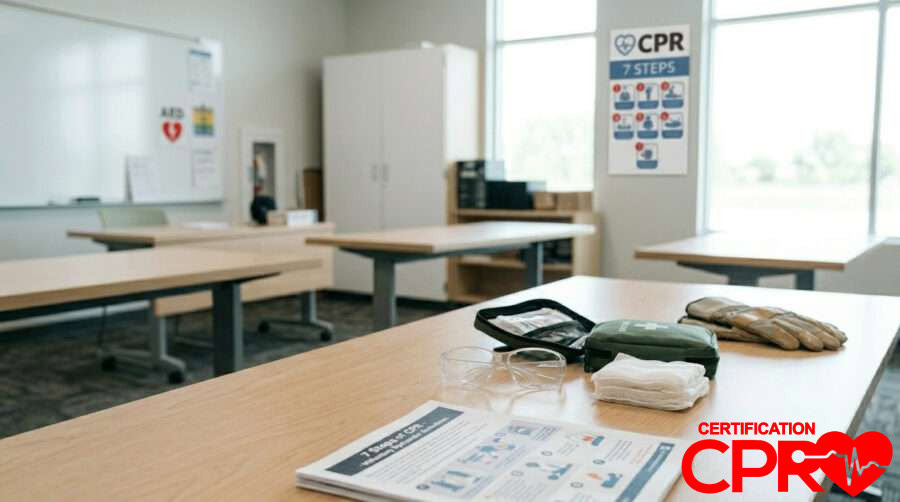
A seven-step CPR list is useful because it gives a chaotic emergency a clear order. A person has collapsed in front of you — maybe at a restaurant on Mesa Street, maybe at a park in Northeast El Paso, maybe in the hallway of the building where you work. The number of steps is not what matters. What matters is that there is a sequence, and you can move through it without standing still.
The exact teaching format can vary depending on the class or chart you learned from, but the steps below capture the basic public response flow this question is looking for. Different training programs sometimes phrase the steps differently or combine two actions into one, but the underlying order is consistent.
Use this as a mental map. In an actual emergency, you are not reciting numbers to yourself. You are recognizing what is happening and moving through the response without freezing. That transition from recognition to action is the whole game.
1. Check the Scene and the Person
Make sure the area is safe enough to approach. You do not help anyone by getting hurt on the way in. If there are hazards — traffic, downed wires, an unstable surface — create distance or direct the scene before moving forward. Once it is reasonably safe, approach and check for responsiveness.
Upcoming CPR Class Dates and Times
Tap the person firmly on the shoulder and shout their name or ask loudly if they can hear you. This is the first dividing line in the entire response. An awake, responsive person needs a different kind of help than someone who is completely unresponsive on the ground. That simple check determines everything that follows.
2. Call 911 or Send Someone to Call
If the person is unresponsive, call 911 immediately, or if others are present, point to one specific person and direct them to call. In a crowded space, “someone call 911” is weaker than “you, in the red jacket, call 911 right now and tell them we have an unresponsive adult.” The difference is that the second version assigns the task to a person who cannot walk away and say they thought someone else had it.
If an AED is nearby — in a gym, a school, a public building — send a second person for that at the same time. CPR and early defibrillation belong in the same response whenever possible, and the AED should arrive while CPR is already in progress.
3. Check for Normal Breathing
Look at the chest, listen, and watch for several seconds. Normal breathing has a steady rhythm and visible chest rise. If the person is not breathing at all, or is making occasional gasping sounds, the response needs to move into CPR. This moment costs bystanders the most time, because it looks like something is happening when gasping is present.
Gasping is not normal breathing. Agonal breathing — the slow, irregular, sometimes noisy gasping that can occur in the minutes after cardiac arrest — looks convincingly like breathing because the person’s chest may rise and fall. It is a brainstem reflex, not functional respiration, and it should not delay starting compressions. If the person is unresponsive and only gasping, treat it as cardiac arrest and move forward.
4. Start Chest Compressions
Begin compressions once you have confirmed the person is unresponsive and not breathing normally. Place the heel of one hand on the center of the chest — the lower half of the breastbone — put your other hand on top, interlace your fingers, and keep your arms straight so your body weight does the work rather than your arms alone. Push down at least 2 inches deep for an adult, at a rate of 100 to 120 compressions per minute, and let the chest fully recoil between each compression. Leaning on the chest between compressions reduces effectiveness. This is the part of CPR that turns abstract knowledge into physical skill, which is why hands-on training matters far more than reading about it.
5. Get an AED if One Is Available
If an AED is nearby, bring it into the response as quickly as possible. You do not wait for CPR to be “finished” before using the AED — CPR does not have a natural pause point. The person performing compressions continues while someone else retrieves the device and gets it ready to use.
CPR and AED use belong together in cardiac arrest response. The AED checks the heart’s electrical rhythm and delivers a shock if one is indicated — the device is analyzing whether a shockable rhythm like ventricular fibrillation is present; watch for the pads to make firm contact with bare skin and stay clear when the machine prompts analysis. CPR alone cannot restart a fibrillating heart — the AED is the tool that can. Getting it there faster improves the odds, which is why public buildings in El Paso and elsewhere are required to have them accessible.
6. Follow the AED Prompts
Turn on the AED, expose the chest, apply the pads to the positions shown in the diagram on the pads themselves, clear everyone away from the patient when the machine says to, and follow the spoken instructions. Public AEDs are designed for exactly this situation — they walk the user through every step and do not require the rescuer to interpret a cardiac rhythm.
The AED handles the analysis that a bystander cannot perform alone. If the machine advises a shock, stand clear, deliver it, and return to CPR immediately when the device tells you to continue — the most common error at this step is pausing too long after the shock to watch for a response before restarting compressions. If no shock is advised, do not stop — “no shock advised” means the rhythm does not respond to defibrillation at this moment, not that CPR should stop. Compressions continue either way.
7. Keep Going Until Help Takes Over
Continue CPR and AED-guided care until EMS personnel take over, or until the person shows clear signs of life — purposeful movement, normal breathing, or eyes opening and responding. The final step is not about a dramatic finish. It is about staying steady when the rescue starts to feel repetitive or physically exhausting, which it will. Compressions at the right depth and rate are tiring. If another trained person is present, switch every two minutes.
A seven-step list is still just a list until you have practiced compressions, the AED sequence, and the rescuer handoffs in a real class. The list helps you picture the order. Hands-on practice with a mannequin is what makes the order usable when the stakes are real and the pressure is high.